

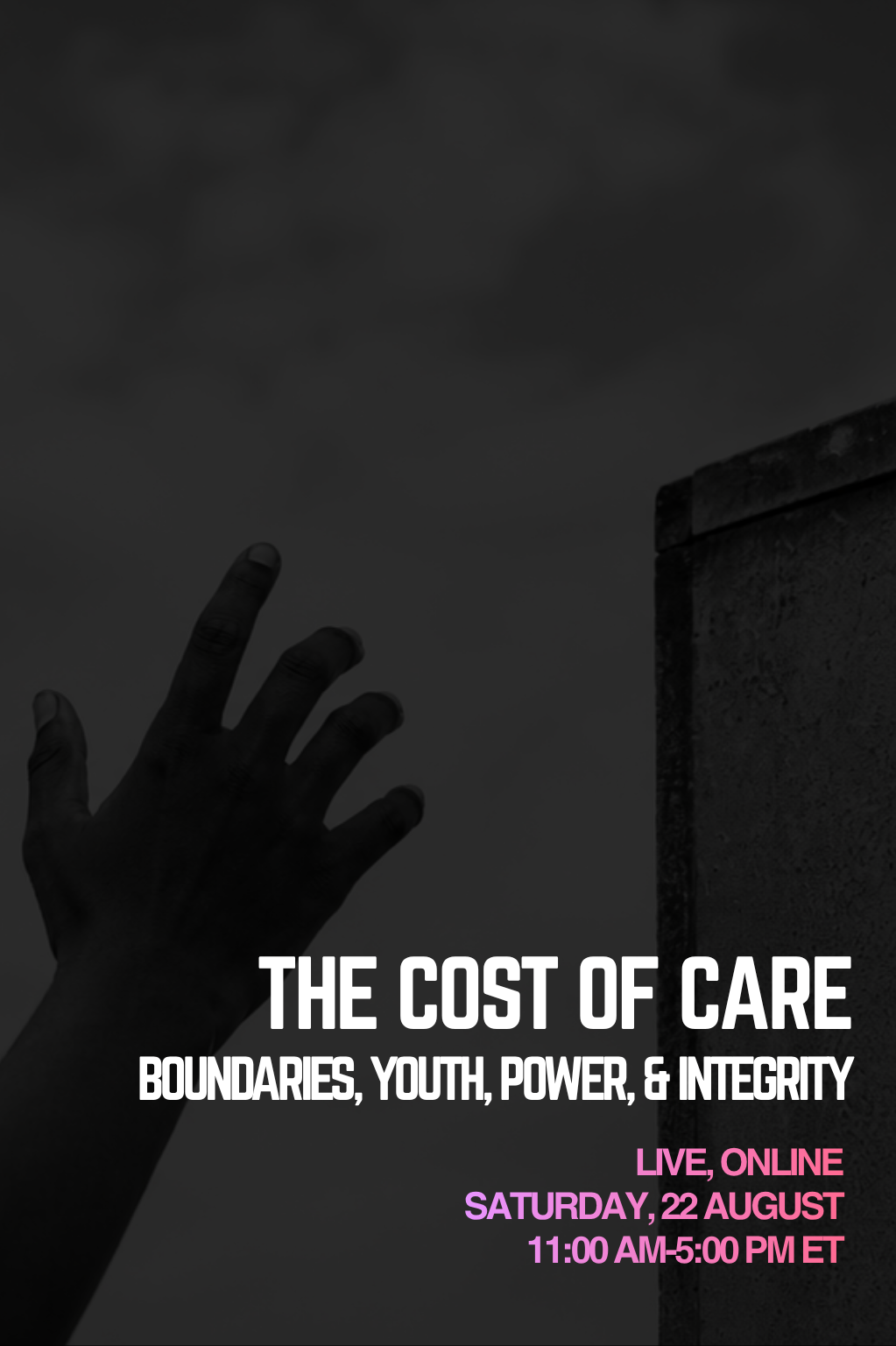
Saturday, 22 August
10:00 am - 5:00 pm ET
Full + Partial Fellowships Available by Application
Apply for a full or partial fellowship by Saturday, 1 August, at 11:59 pm ET. See the details and an application under “Tuition + Fellowships” below.
-
FACILITATORS:
Kamauru Johnson, PhD, Director of Counseling Support Services, Rye Country Day School
Lisa Arrastia, PhD, Founding Director, The Ed Factory
—
ABOUTThe Cost of Caring: Boundaries, Youth, Power, and Integrity is a live, online, scenario-based seminar for educators who work with young people inside and outside of schools.
The seminar is designed for classroom teachers, youth workers, teaching artists, after-school educators, coaches, program staff, school leaders, counselors, paraprofessionals, and others responsible for creating safe, ethical, and caring learning spaces.
The Cost of Care begins with participants’ own lived understandings of boundaries: what they believe boundaries are, which boundaries are easy for them to set, which are hard to recognize or keep, and why. From there, participants examine how boundaries become complicated in classrooms, youth centers, after-school programs, arts spaces, advisory and mentoring relationships, and other settings where adults are responsible for children and adolescents. Through guided reflection, discussion, writing, and practical scenarios, participants will consider how affection, care, authority, cultural expectations, adult emotional needs, privacy, disclosure, confidentiality, favoritism, physical space, digital communication, and mandatory reporting responsibilities shape adult-child relationships.
The seminar draws from liberatory traditions that treat boundaries as practices of care, accountability, embodied self-awareness, and social change. It is grounded in the belief that boundaries are not simply rules or restrictions. Boundaries are ethical practices that help educators protect young people, protect themselves, and build learning spaces where trust, care, responsibility, and accountability can coexist. Participants will examine why some boundaries feel easy to set while others feel uncomfortable, harsh, unclear, or emotionally difficult. They will also consider how personal history, professional culture, fear of disappointing young people, institutional pressure, power, race, gender, class, sexuality, disability, family expectations, and prior experiences with authority can affect how adults notice, set, and keep boundaries.
The Cost of Care includes a basic introduction to child abuse reporting and mandated reporter responsibilities. A visiting lawyer will join the seminar to review legal and ethical considerations related to adult boundaries with children, including appropriate communication, confidentiality, disclosures of harm, documentation, reporting responsibilities, and the limits of adult privacy with young people. Because laws vary by state and setting, the legal portion will provide general education and guidance rather than legal advice. Participants will be encouraged to consult their own state laws, school policies, organizational protocols, and supervisors.
Participants will leave with a boundaries framework, a set of scenario-based decision-making tools, and a written draft of personal and professional boundary commitments they can adapt for their classroom, program, youth center, or educational setting.
—
FORMAT: Live, online via Zoom.
-
This seminar is for educators and others who work with young people inside and outside of schools, including teachers, counselors, social workers, youth workers, mentors, coaches, program staff, school leaders, and nonprofit staff.
It is useful for undergraduate and graduate teaching and social work licensure students, early-career teachers, experienced educators, and program leaders who want to think more clearly about care, closeness, communication, power, privacy, legal responsibility, and ethical relationships with young people.
-
READINGS
Required readings may be provided electronically to participants before the workshop. We recommended reading the texts below before or after the workshop:
Lama Rod Owens, Love and Rage: The Path of Liberation through Anger (Berkeley, North Atlantic Books, 2020).
Leah Lakshmi Piepzna-Samarasinha, Beyond Survival: Strategies and Stories From the Transformative Justice Movement (Chico, AK Press, 2019).
Cristien Storm, Empowered Boundaries: Speaking Truth, Setting Boundaries, and Inspiring Social Change (Berkeley: North Atlantic Books, 2018).
TOOLS + SPACE
Participants will also need:
A quiet place to join the seminar on Zoom
A smartphone with basic voice and video recording capability
Access to Google Drive
A laptop or desktop computer
-
Tuesday, 22 September, 6-7 pm ET
Live, online via ZoomTuition: $0
For those who want to become more comfortable with basic tech, or who are new to Zoom, Google Drive, or working online, a live, online tutorial will be offered before the seminar begins. The session will cover the basics needed to participate comfortably, including joining Zoom, sharing your screen, accessing shared files, and other simple tools used in the seminar.No prior technical experience is required.
You must first register for the seminar, then complete the Low-Tech Basics Tutorial registration form.
Low-Tech Basics Tutorial registration ends on 1 September at 11:59 pm EASTERN. -
With seven hours of live instruction, plus eight hours of reading and experiential assignments, this seminar may be eligible for 1 Graduate-Level Extension Credit through our partner university.
Even if you are not currently on a unit-based pay scale, credits may benefit you in the future. If you switch districts or roles where credit-based salary advancement applies, having credit already earned ensures you’re eligible without delay.
Participants are responsible for confirming acceptance, transcript requirements, deadlines, and the applicability of units with their employing district or intended institution prior to enrolling with the partner university.
The Ed Factory seminar payment and university credit enrollment are two separate transactions.Enroll in The Ed Factory seminar
Enroll with the partner university for academic credit
—
Our partner university enrollment deadline for this seminar will be 22 August 2026.
—
If you’re interested in graduate-level extension credit, please contact us. -
→ Tuition: $125
→ Fellowship access: Full and partial fellowships will be offered by application. Full fellowship covers The Ed Factory tuition. Partial fellowship tuition is $60.
Fellowship applications are due: Friday, 14 August 2026, by 11:59 p.m. Eastern. Decisions will be emailed by 16 August. Apply for a Fellowship.
—Additional reduced-rate access may be available when cost is a barrier. Please contact us to discuss options.
—
Tuition supports seminar design and facilitation, course materials, attorney Q&A, and the sustained preparation required for reflective writing, discussion, and careful engagement with participants’ questions and boundary scenarios.
—
The Ed Factory tuition does not include graduate-level extension credit through our partner university or any required books participants may need to purchase separately. -
Reduced-rate access may be available when cost is a barrier. Please reach out through Connect if you would like to discuss options.